
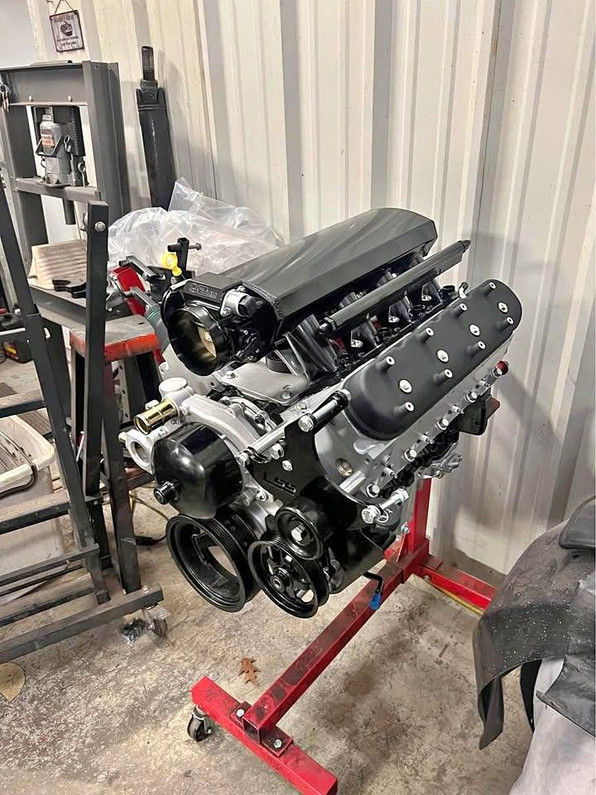
Repairing Stripped LS Head Bolt Threads: Stock Sizes & 1/2" Conversion Options
By Dennis Bandy
Former Master Tech & Founder of Wise Auto Tools
If you're tackling head bolt thread repairs on an aluminum GM LS series block, you already know there isn’t much room for error. Over the last two decades of selling thread repair kits and answering technical calls, I’ve seen just about every stripped thread situation imaginable on these engines.
Whether you pulled the factory threads out during a head gasket job or you're up-sizing to aftermarket 1/2" stud conversion, getting the right insert size and tooling depth is the difference between a rock-solid repair and a scrapped block. Our kits are used with the block still in the car, with heads removed.
How to Identify Your Factory Head Bolt Size
Before you order any tooling, you need to verify what bolt thread pitch your block actually has. GM used a couple of primary setups on these engines:
Standard M11x2.0: The quickest way to tell if your engine takes the standard M11x2.0 repair kit is to look at the top deck rail. If your block uses the smaller M8x1.25 bolts along the upper edge alongside the main head bolt holes, your main threads are M11x2.0.
Performance M12x1.75: If your engine uses the larger M12x1.75 main head fasteners (found on select heavy-duty or specialized aftermarket performance blocks), it will not use any M8 bolts on the head deck.
Note: If the small M8 outer bolt threads themselves are damaged, we use a specific plate setup (1812CORE-PLATE) to fix those.
Because GM shifted bolt lengths and configurations across different model years, we always recommend double-checking your specific vehicle and engine setup before ordering. You can check our detailed product listings on wiseautotools.com 3700 kit and the EN42386-50 for more application info, or just give us a call at 1-800-733-4733 and we'll help you match the right kit to your engine.
Standard Repair Kits (M11x2.0 vs. M12x1.75)
For a standard factory thread repair that hasn't been modified before:
M11x2.0 Blocks: You’ll want the TIME-SERT 3700 kit. A common mistake I see people make is ordering the 2200 kit—keep in mind the 2200 is M11x1.5 (used mostly on Toyota, Kia and Hondas), which will ruin your threads if used in an LS block. The 3700 has the proper 2.0 thread pitch and extended tooling designed to reach down past the unthreaded counterbore.
M12x1.75 Blocks: These require the Time Sert EN 42385-50 kit (TIME-SERT M12x1.75 head bolt kit), which features the extra-long tooling specifically engineered to reach the deep thread starting point in GM aluminum blocks.
Fixing Stripped 1/2" Stud Conversions (TIME-SERT 15100)
We often get asked about 1/2" head stud conversions. Upsizing from the stock M11 or M12 threads to a 1/2" stud is a mod high-performance guys use to get extra clamping force in high-horsepower or boosted applications.
As a general rule, we recommend sticking with the original factory thread size whenever possible so you can continue using standard torque-to-yield (TTY) head bolts. Factory TTY bolts provide consistent stretch and superior long-term seal reliability. Converting to 1/2" studs is far less common, and it's a trade-off where builders choose maximum clamping performance over factory reliability.
However, if you're working on a build where performance takes priority, or if you bought a block that was already converted to 1/2" studs and stripped out, 1/2" was never an original GM factory size. Because of that, there isn't a dedicated off-the-shelf "1/2-Inch LS Repair Kit."
We regularly help engine builders adapt the TIME-SERT 15100 kit (originally engineered as a Subaru 1/2" conversion kit) to fix these stripped 1/2" stud threads.
Here is what you need to know if you're adapting the 15100:
Tooling Length: The stepped drill and tap in the 15100 set have enough extra reach to handle the deep deck clearance on an LS casting.
Manual Depth Setup: Because it's an adapted use, you have to manually set your drill stop collar. Removing the seal from the set screw on the stop collar will be necessaary. Measure your block's hole depth carefully and adjust the collar on the stepped drill so you clean out enough depth for the insert without drilling into the water jacket.
First-Time Repairs Only: The 15100 kit is strictly for first-time repairs (converting directly from a stripped original hole or a standard 1/2" thread). If a 1/2" repair insert was already installed in the hole and pulled out a second time, you'll need to step up to a larger outer-diameter "Big-Sert" kit.
Need Help Choosing the Right Kit?
Every engine build has its own quirks and guessing on thread repairs gets expensive fast. If you're unsure about your thread size, need to double-check tooling depth, or want to make sure you're getting the exact insert length for your block:
Check the application information right on our product pages at wiseautotools.com.
Call us directly at 1-800-734-8665. You'll get real tech support from folks who actually know these tools and how they work in the shop.
Recent Posts
-
Repairing Stripped LS Head Bolt Threads: Stock Sizes & 1/2" Conversion Options
By Dennis Bandy Former Master Tech & Founder of Wise Auto Tools If you're tackling head bolt thread …6th Nov 2026 -
Why Time-Sert Tooling Have Square Ends
When unboxing a Time-Sert thread repair kit—such as the popular 1015 kit or other engine-specific th …18th Sep 2026 -

Top 5 Causes of Thread Failure
Thread Stripping (Tensile Shear Failure) What happens: The internal or external threads shear off co …29th Jun 2026